
 Image 1 of 1
Third Intermediate Period, 21st-24th Dynasty, 1069-715 BC
Height: 1.9 cm; Width: 2.7 cm
Provenance: Collection of George and Dora Mathues, Philadelphia, USA acquired in Egypt in the early 1960s and thence by descent
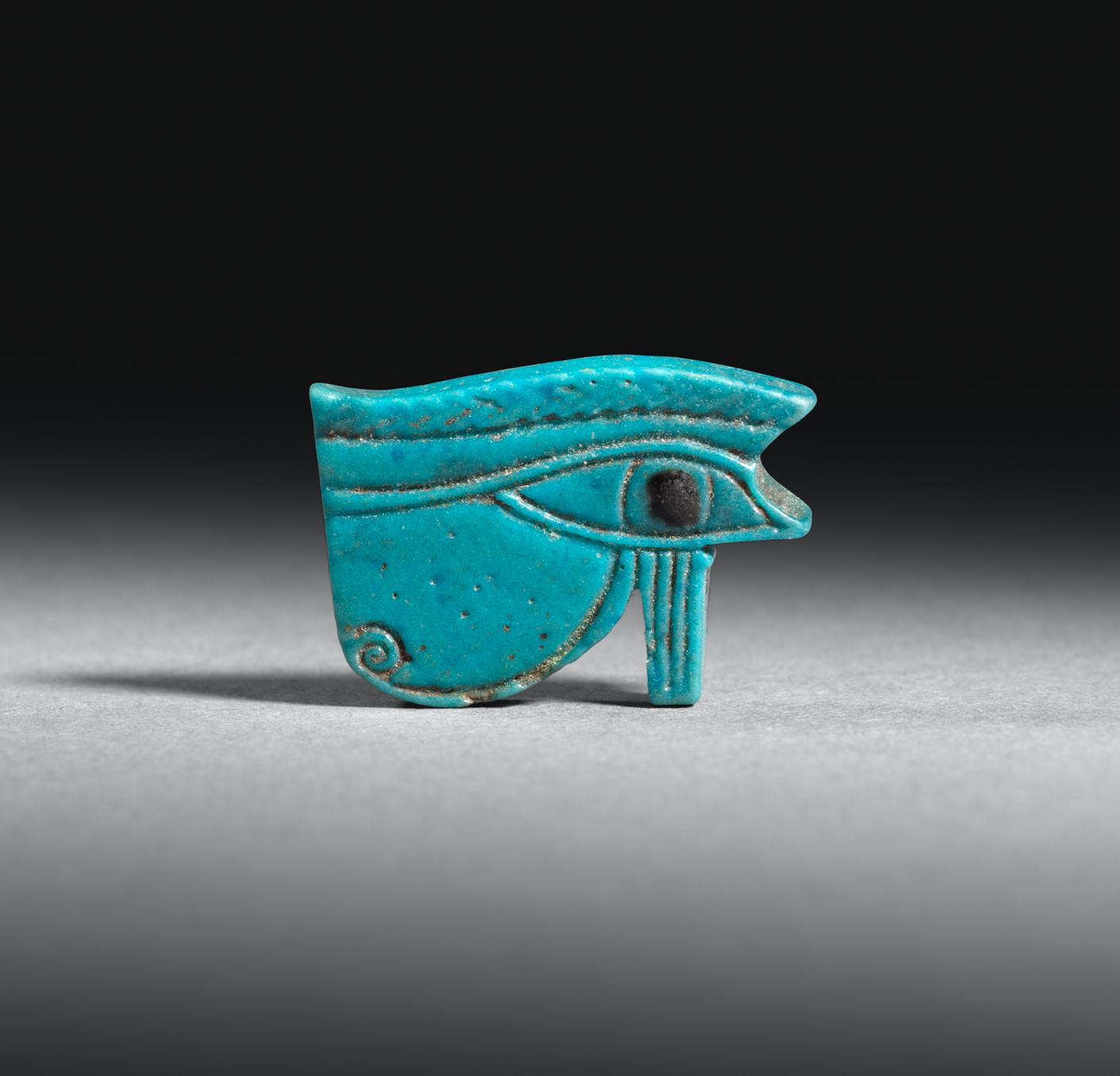
The flat, bright blue faience amulet with moulded details of eyebrow, extended cosmetic line, the pupil picked out in black glaze. Pierced longitudinally for suspension.
Wedjat, meaning 'the sound one', is generally thought to refer to the left (moon) eye of Horus the elder, plucked out by Seth and healed by Thoth, rather than the right eye (sun). The moon can be seen as 'injured' as it wanes and 'restored' as it waxes each month, but the term can apply to both eyes, as the uninjured sun eye is therefore 'sound', and both left and right eyed amulets are found.
Condition: Intact
Literature: For an almost exact comparison, see Sir W. M. Flinders Petrie, 'Amulets' (reprinted Warminster, 1972) plate XXV, no. 138ad. For the type, see also Carol Andrews, 'Amulets of Ancient Egypt' (London, 1994) fig. 46b colour plate between pages 40 & 41.
Third Intermediate Period, 21st-24th Dynasty, 1069-715 BC
Height: 1.9 cm; Width: 2.7 cm
Provenance: Collection of George and Dora Mathues, Philadelphia, USA acquired in Egypt in the early 1960s and thence by descent
The flat, bright blue faience amulet with moulded details of eyebrow, extended cosmetic line, the pupil picked out in black glaze. Pierced longitudinally for suspension.
Wedjat, meaning 'the sound one', is generally thought to refer to the left (moon) eye of Horus the elder, plucked out by Seth and healed by Thoth, rather than the right eye (sun). The moon can be seen as 'injured' as it wanes and 'restored' as it waxes each month, but the term can apply to both eyes, as the uninjured sun eye is therefore 'sound', and both left and right eyed amulets are found.
Condition: Intact
Literature: For an almost exact comparison, see Sir W. M. Flinders Petrie, 'Amulets' (reprinted Warminster, 1972) plate XXV, no. 138ad. For the type, see also Carol Andrews, 'Amulets of Ancient Egypt' (London, 1994) fig. 46b colour plate between pages 40 & 41.