
 Image 1 of 3
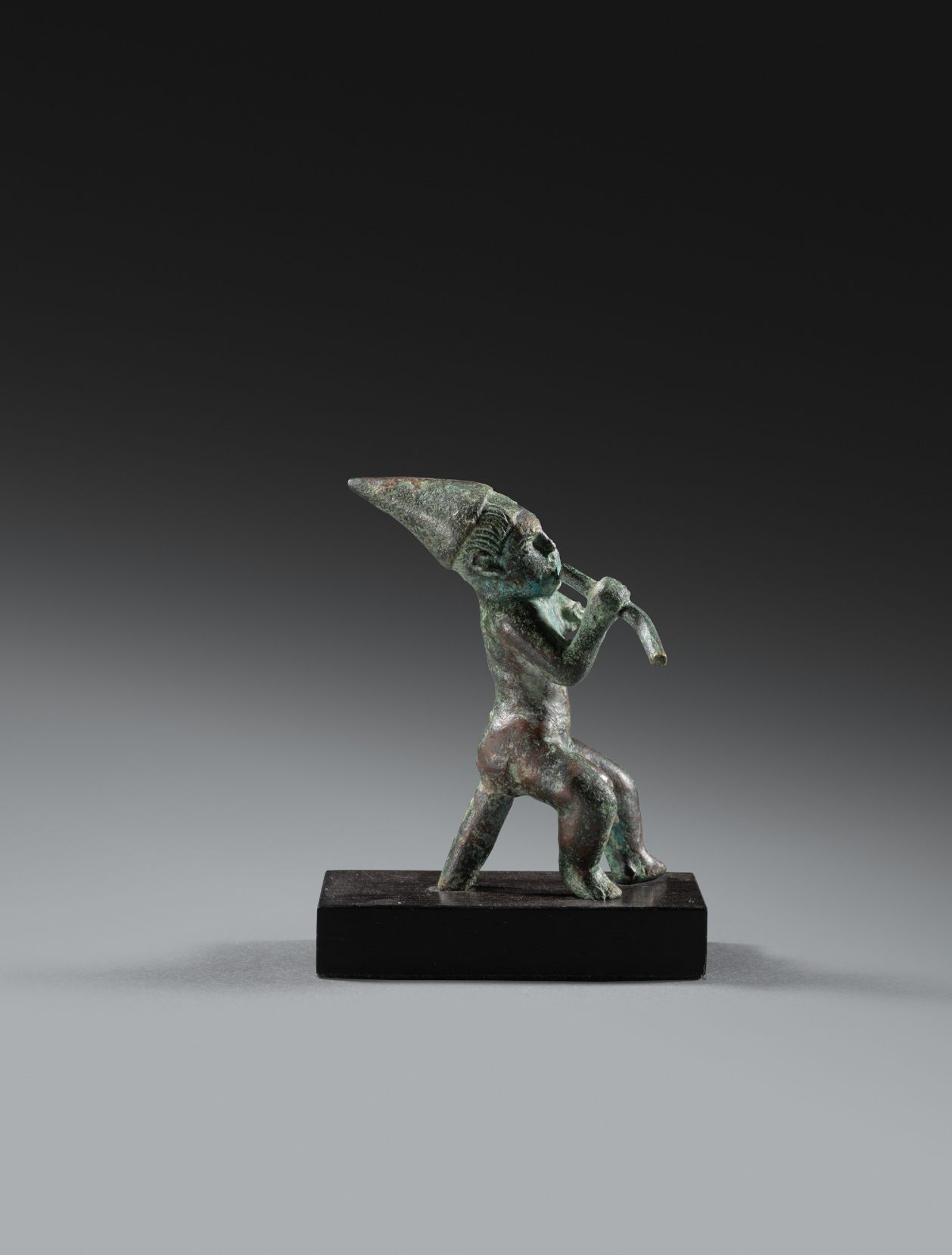 Image 2 of 3
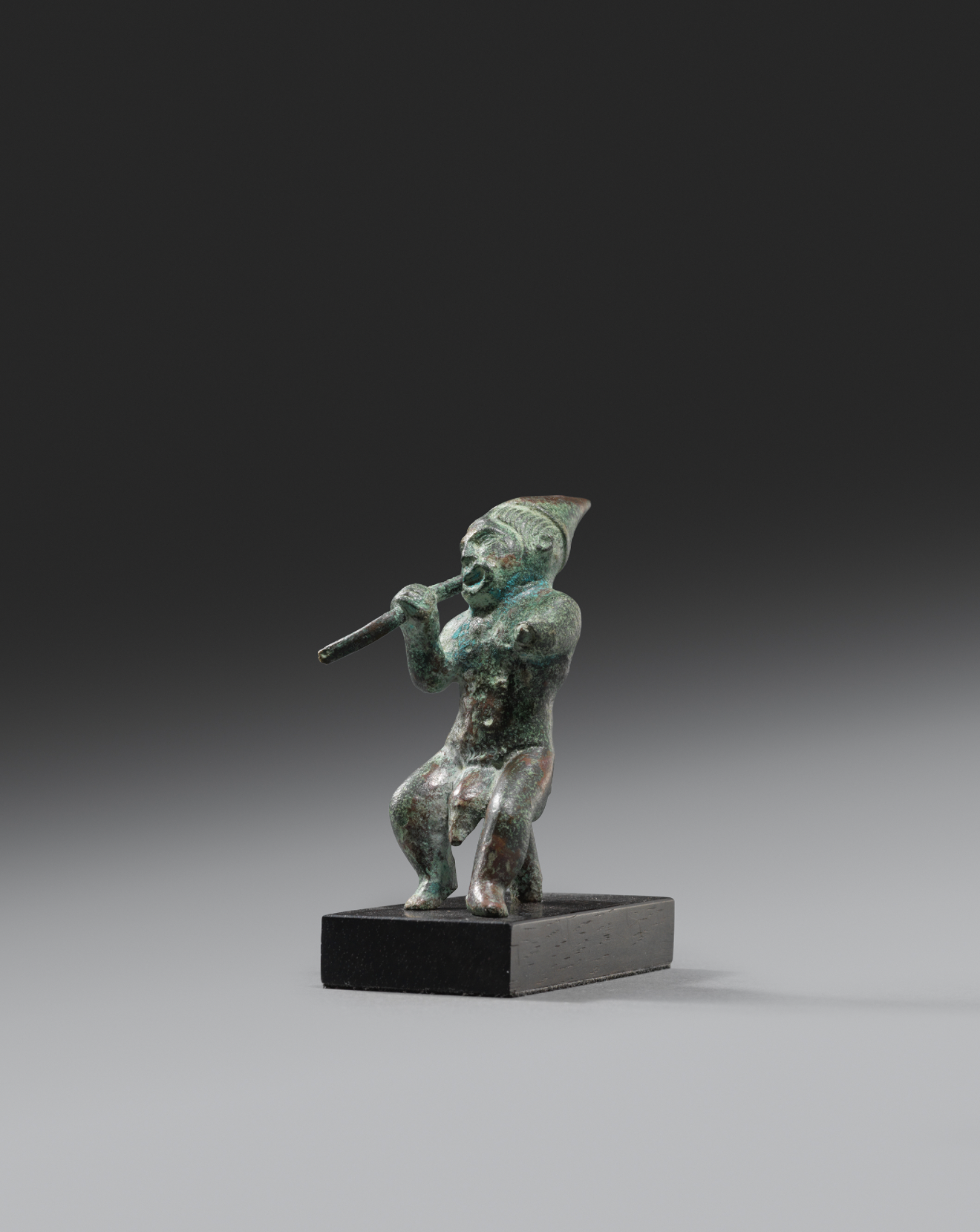 Image 3 of 3
Alexandrian, 1st century BC
Height: 5.3 cm
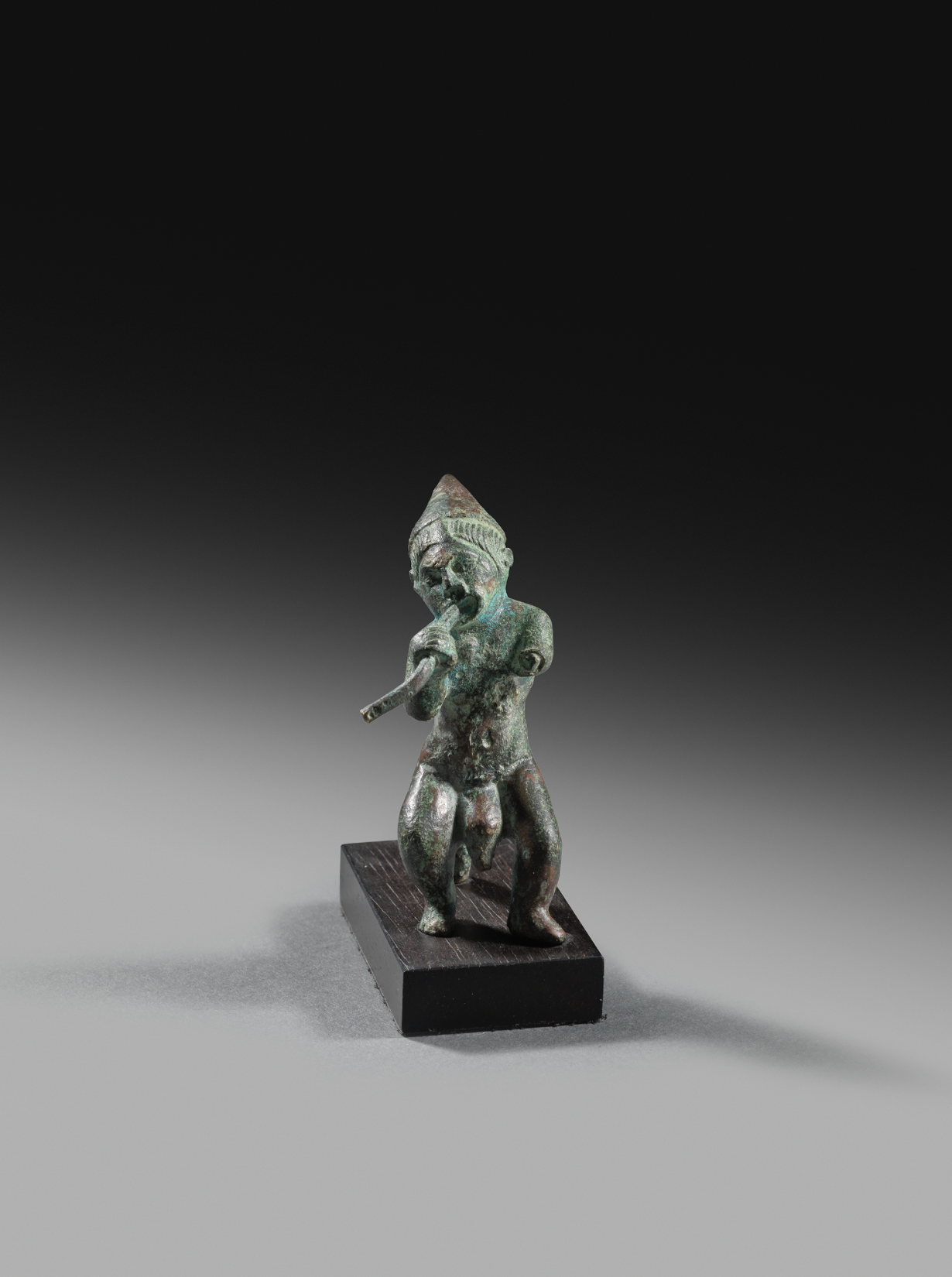
Bronze ithyphallic dwarf depicted playing the pipes. He half sits balanced upon a projecting strut; his short legs bent at the knee either side of his enlarged phallus. His right arm is bent at the elbow to hold a pipe to his open mouth, his left arm, now missing would have held a similar pipe. On his head he wears a conical hat or pilos from which long slightly curled locks of hair escape.
Dwarf figures were a popular subject in Alexandria. They often appeared as caricatures with exaggerated features and deformities. Such figures may have had a religious significance representing dancers and musicians associated with the ecstatic orgiastic celebrations for Dionysus or Cybele or simply be intended as a general evocation of festivity. Ptolemaic papyri refer to dancers, including dwarves, hired for religious and private occasions.
Literature: J. J. Pollitt, 'Art in the Hellenistic Age' (Cambridge, 1986) p. 138, fig 149 shows two bronze dancing dwarves (found in the Mahdia shipwreck and now in the Bardo Museum, Tunis). One of them also illustrated in Arielle Kozloff et al, 'The Gods Delight, The Human Figure in Classical Bronze' exhibition catalogue, Cleveland, 1988, p.276, fig.XIX. A fragmentary marble example in the collection of the Metropolitan Museum of Art, New York reveals similar observation of the dwarf's musculature (accession number 26.7.1403).
Provenance: European private collection 1990s; With Rupert Wace Ancient Art, 2003; Private collection of Guy Goudchaux, London, UK acquired from the above, May 2003; With RWAA since 2012 (purchased back directly from Guy Goudchaux)
Alexandrian, 1st century BC
Height: 5.3 cm
Bronze ithyphallic dwarf depicted playing the pipes. He half sits balanced upon a projecting strut; his short legs bent at the knee either side of his enlarged phallus. His right arm is bent at the elbow to hold a pipe to his open mouth, his left arm, now missing would have held a similar pipe. On his head he wears a conical hat or pilos from which long slightly curled locks of hair escape.
Dwarf figures were a popular subject in Alexandria. They often appeared as caricatures with exaggerated features and deformities. Such figures may have had a religious significance representing dancers and musicians associated with the ecstatic orgiastic celebrations for Dionysus or Cybele or simply be intended as a general evocation of festivity. Ptolemaic papyri refer to dancers, including dwarves, hired for religious and private occasions.
Literature: J. J. Pollitt, 'Art in the Hellenistic Age' (Cambridge, 1986) p. 138, fig 149 shows two bronze dancing dwarves (found in the Mahdia shipwreck and now in the Bardo Museum, Tunis). One of them also illustrated in Arielle Kozloff et al, 'The Gods Delight, The Human Figure in Classical Bronze' exhibition catalogue, Cleveland, 1988, p.276, fig.XIX. A fragmentary marble example in the collection of the Metropolitan Museum of Art, New York reveals similar observation of the dwarf's musculature (accession number 26.7.1403).
Provenance: European private collection 1990s; With Rupert Wace Ancient Art, 2003; Private collection of Guy Goudchaux, London, UK acquired from the above, May 2003; With RWAA since 2012 (purchased back directly from Guy Goudchaux)