
 Image 1 of 1
6th-4th century BC
Height: 2.6 cm; Length: 9.1 cm
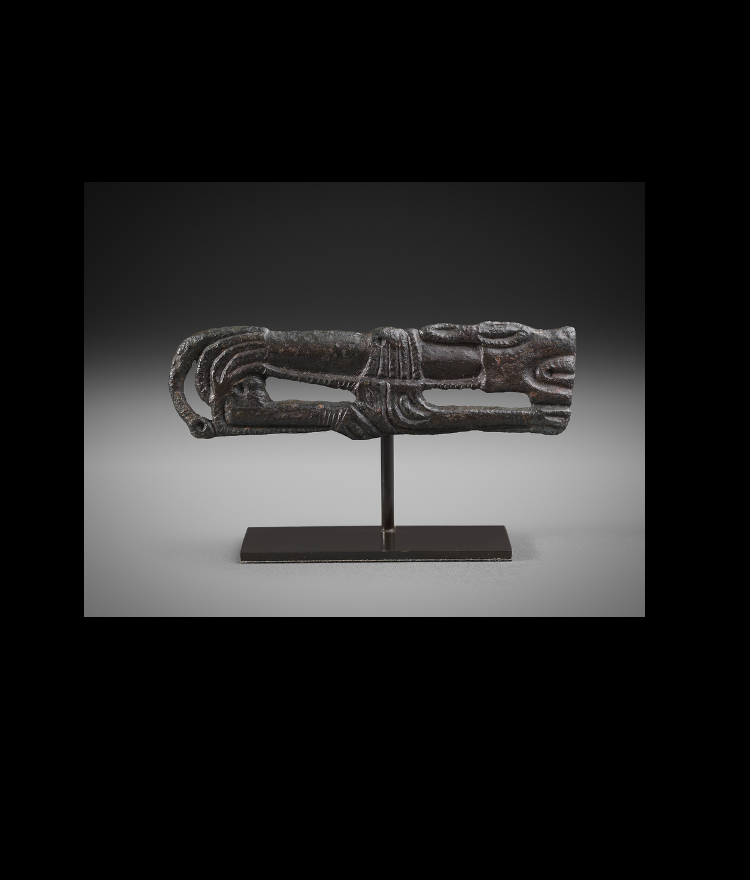
Cast in the shape of a crouching wolf in right profile, its legs tucked beneath its elongated body, with ribs, haunches, and claws defined with incised rope-like mouldings. The schematised head with almond-shaped eye, flattened ear, and broad, slightly flaring muzzle, the teeth and tongue exposed. On the reverse, a horizontal hook behind the head and a loop behind the tail.
Thracian youths were often awarded a belt as a sign of his having reached maturity and completed his initiation into manhood. The wolf-shaped buckle is therefore symbolic in this context, representing the young warrior's wolf-like strength.
Condition: Intact. Dark green-black patina overall. Some wear to edges.
Literature: For a near identical buckle, see E. C. Bunker, Nomadic Art of the Eastern Eurasian Steppes. The Eugene V. Thaw and Other New York Collections, New Haven and London, 2002, p. 95, no. 60. Another example was excavated in Apollonia, Bulgaria; cf. I. Marazov (ed.) Ancient Gold: The Wealth of the Thracians. Treasures from the Republic of Bulgaria, New York, 1998, p. 62, fig. 17.
Provenance: Private collection, UK, acquired in 1991