
Viking Rus Silver cross inlaid with Niello
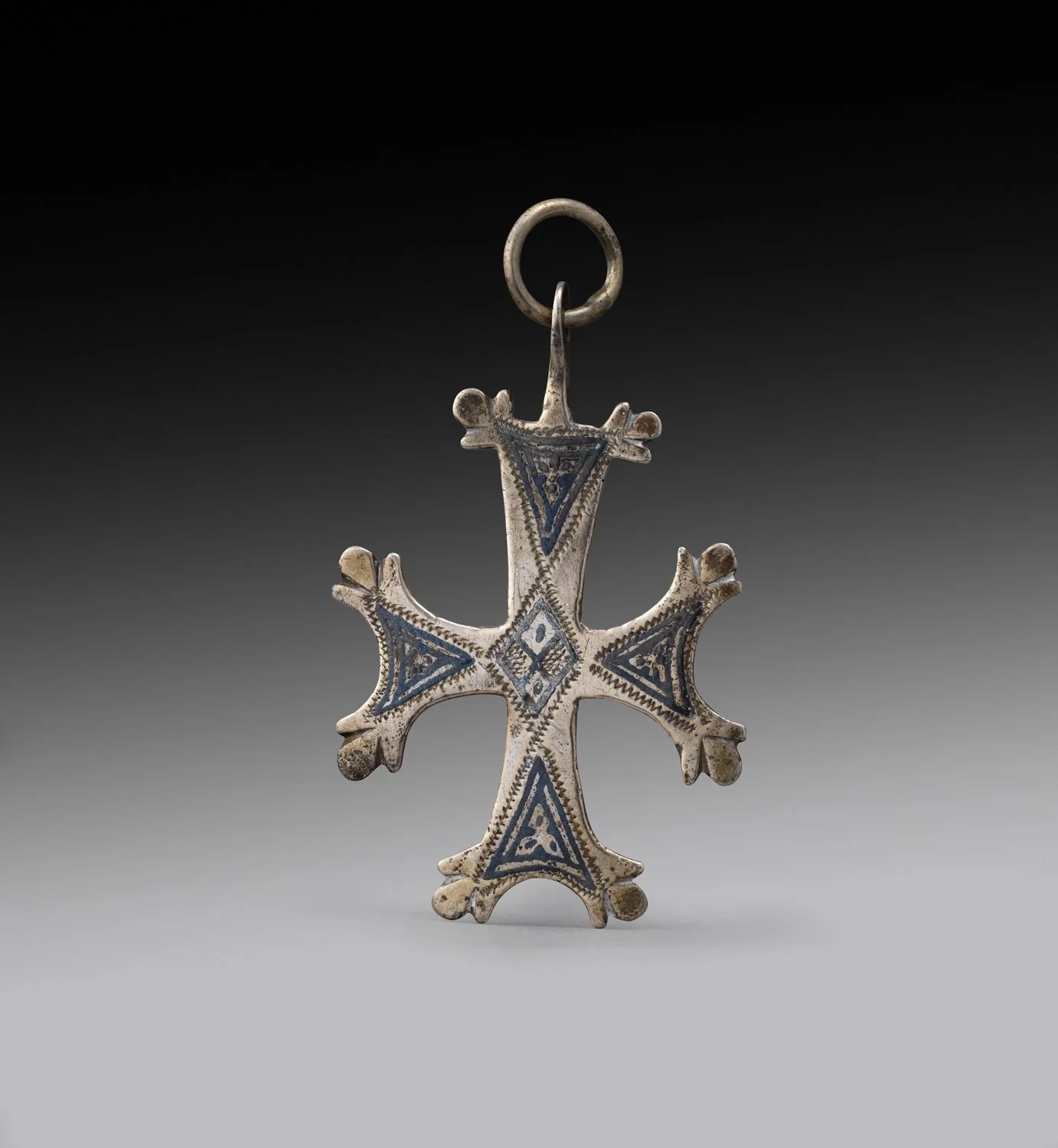
10th - 12th century AD
Height: 6.5 cm
An ornate silver cross of Byzantine form inlaid with niello with original suspension loop. Triangular sections of the niello inlaid panels point towards a lozenge shaped central panel. The ends of the four arms of the cross are scalloped and the terminals end with an almost floral shape.
Objects such as this may have been 'presentation objects' like the crosses mentioned in the Book of Ceremonies (I, chapters 19, 22) and been bestowed by the emperor on a variety of dignataries.
Culturally, the Viking Rus existed in a transitional world. Although their origins lay in Norse pagan traditions, they were increasingly influenced by the Christian Byzantine sphere. The lands of the Rus’ underwent a profound religious transformation in the late 10th century. In 988 AD, Prince Vladimir I of Kiev formally adopted Eastern Orthodox Christianity, initiating the large-scale conversion known as the Christianization of Kievan Rus’. This process was deeply influenced by Byzantine missionaries and cultural models, embedding Byzantine artistic and religious forms, such as this cross, within the emerging Christian identity of the region. Earlier precedents, including the baptism of Princess Olga of Kiev in 957, demonstrate that these connections had been developing for decades prior.
Literature: A similar cross can be found in the collection of Dumbarton Oaks, Washington DC, which was exhibited and published: Byzantium 330-1453, Royal Academy 25 October 2008-22 March 2009, p.115 fig 23
Provenance: UK collection 1970s to 1990s, acquired 1986; With Rupert Wace Ancient Art, 2011
£7,800