
 Image 1 of 1
c. 1st-2nd century AD
Length: 10mm, Width: 9mm Width: 2mm
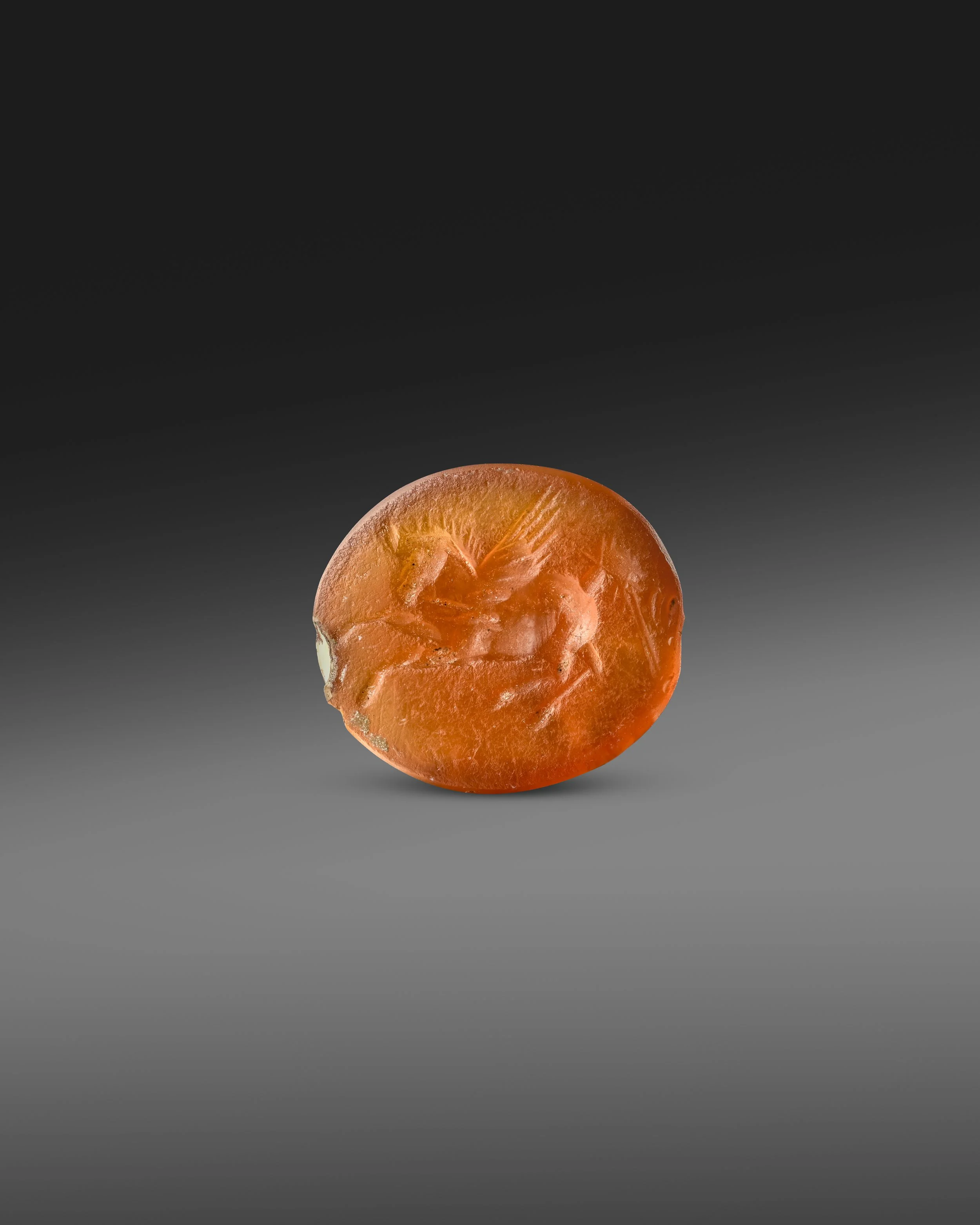
The intaglio depicting a flying Pegasus towards the left, carved on an oval bright orange translucent carnelian gem.
In Greek and Roman mythology, Pegasus was born from the severed head of the Gorgon Medusa when she was slain by Perseus. He later became the mount of Bellerophon, assisting him in defeating the fire-breathing Chimera.
The image of the winged horse used as a seal may therefore evoke this mythological narrative. Pegasus is also represented as a constellation, and when a star accompanies his image, an intaglio may be interpreted as referring to this celestial form. Such imagery could serve to commemorate the moment of owners’ birth. The figure of Pegasus was highly popular in both Greek and Roman cultures. Engraved gems depicting the mythical horse were believed to benefit warriors by granting courage and speed, while also symbolising immortality in Greek thought.
Carnelian is a type of chalcedony, a variety of polycrystalline quartz that displays a vitreous lustre.
Literature: Three similar examples can be found in the British Museum (orange Sard, 1st-2nd century AD, inv. no. 1799,0521.21); Staatliche Münzsammlung, München (orange Carnelian, 1st century AD, without inv. No.) and the Rijksmuseum van Oudheden, Leiden (orange Carnelian, 1st century AD, inv. no. GS-00263).
c. 1st-2nd century AD
Length: 10mm, Width: 9mm Width: 2mm
The intaglio depicting a flying Pegasus towards the left, carved on an oval bright orange translucent carnelian gem.
In Greek and Roman mythology, Pegasus was born from the severed head of the Gorgon Medusa when she was slain by Perseus. He later became the mount of Bellerophon, assisting him in defeating the fire-breathing Chimera.
The image of the winged horse used as a seal may therefore evoke this mythological narrative. Pegasus is also represented as a constellation, and when a star accompanies his image, an intaglio may be interpreted as referring to this celestial form. Such imagery could serve to commemorate the moment of owners’ birth. The figure of Pegasus was highly popular in both Greek and Roman cultures. Engraved gems depicting the mythical horse were believed to benefit warriors by granting courage and speed, while also symbolising immortality in Greek thought.
Carnelian is a type of chalcedony, a variety of polycrystalline quartz that displays a vitreous lustre.
Literature: Three similar examples can be found in the British Museum (orange Sard, 1st-2nd century AD, inv. no. 1799,0521.21); Staatliche Münzsammlung, München (orange Carnelian, 1st century AD, without inv. No.) and the Rijksmuseum van Oudheden, Leiden (orange Carnelian, 1st century AD, inv. no. GS-00263).