
 Image 1 of 1
c. 1st-2nd century AD
Length: 12mm, Width: 9mm, Depth: 3mm
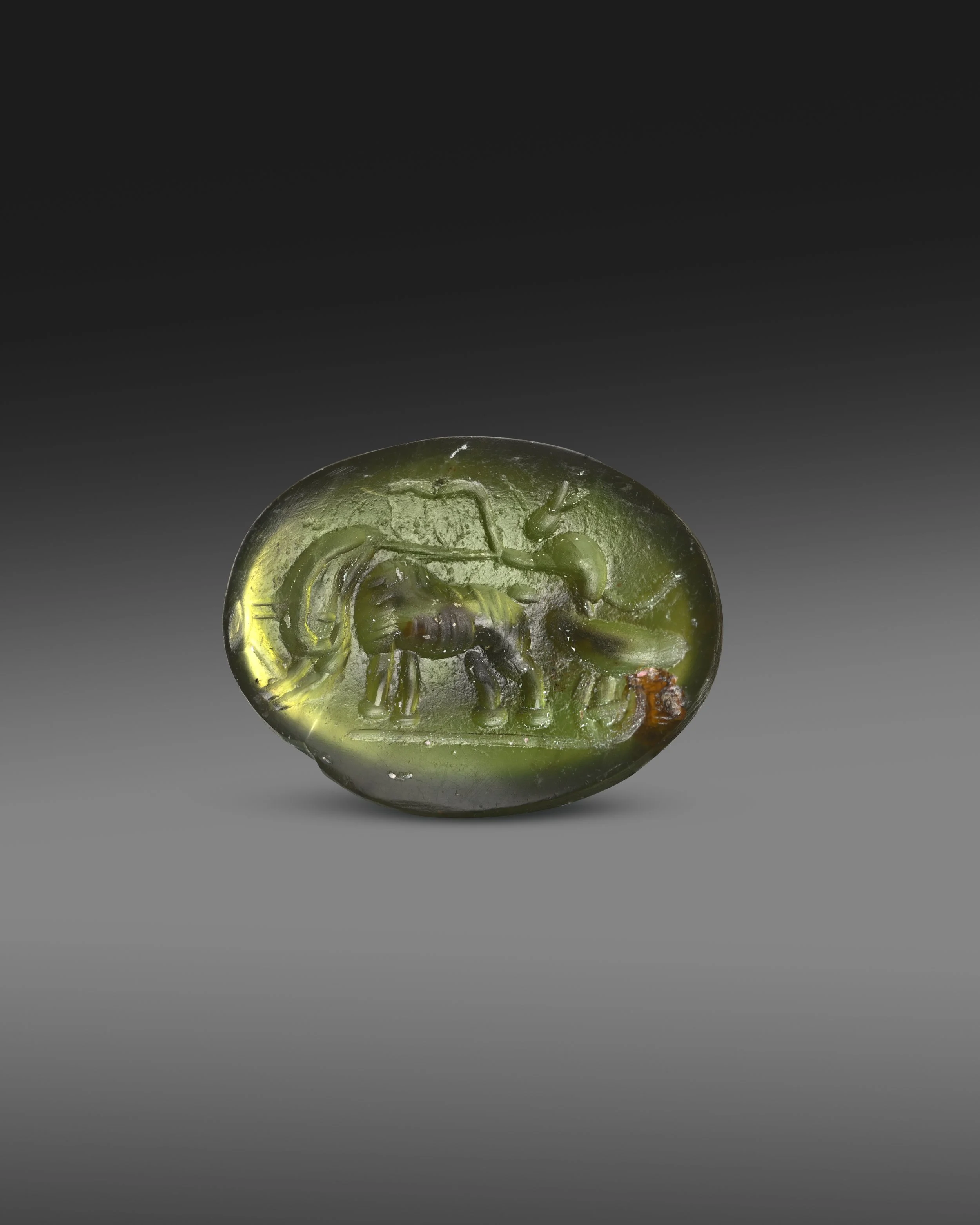
Dark green translucent prase oval tapered tablet intaglio depicting a scene of a mouse with a whip on a chariot, pulled by an elephant.
During the Roman Imperial period, numerous images depict a mouse as an auriga; however, very few show it driving an elephant, as it more commonly drives roosters. This type of engraving fits within the conceptual framework of the “world turned upside down”, in which the transformation of the charioteer into a mouse is interpreted in a parodic key, whereby the immensely large (the elephant) is subjugated by the immensely small (the mouse). Generally, such images - where an animal replaces a human figure - are interpreted as charms intended to attract good fortune or to avert misfortune.
Prase is a type of chalcedony, a variety of polycrystalline quartz that displays a vitreous lustre.
Literature: Two similar examples can be found in the Staatliche Münzsammlung, Munich (red carnelian, octagonal, 2nd-3rd century AD) and an octagonal red carnelian, 2nd-3rd c. AD, from a private collection.
c. 1st-2nd century AD
Length: 12mm, Width: 9mm, Depth: 3mm
Dark green translucent prase oval tapered tablet intaglio depicting a scene of a mouse with a whip on a chariot, pulled by an elephant.
During the Roman Imperial period, numerous images depict a mouse as an auriga; however, very few show it driving an elephant, as it more commonly drives roosters. This type of engraving fits within the conceptual framework of the “world turned upside down”, in which the transformation of the charioteer into a mouse is interpreted in a parodic key, whereby the immensely large (the elephant) is subjugated by the immensely small (the mouse). Generally, such images - where an animal replaces a human figure - are interpreted as charms intended to attract good fortune or to avert misfortune.
Prase is a type of chalcedony, a variety of polycrystalline quartz that displays a vitreous lustre.
Literature: Two similar examples can be found in the Staatliche Münzsammlung, Munich (red carnelian, octagonal, 2nd-3rd century AD) and an octagonal red carnelian, 2nd-3rd c. AD, from a private collection.