
 Image 1 of 1
c. 1st-2nd century AD
Length: 16mm, width: 13mm, depth: 2mm
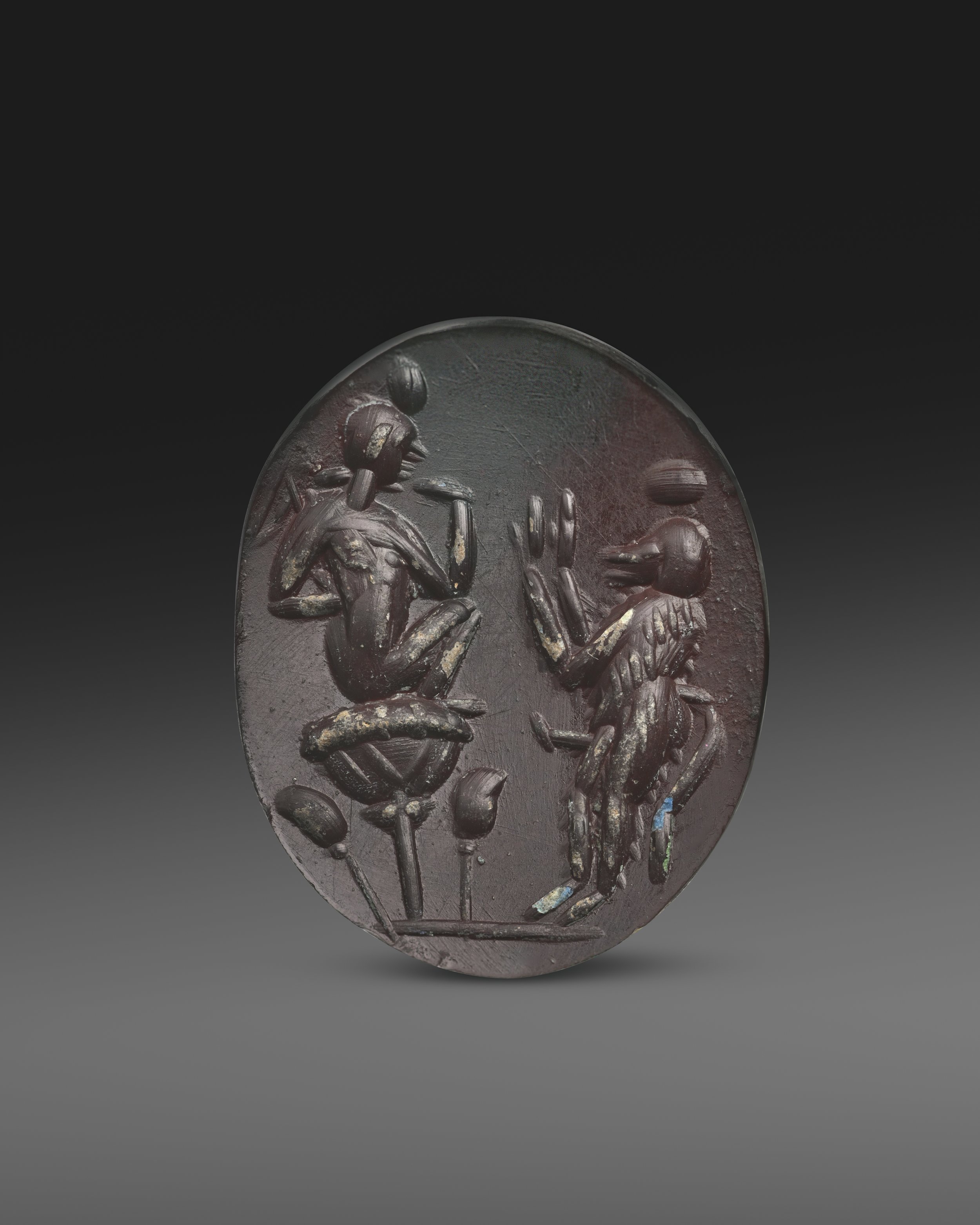
Red and green opaque bloodstone oval tapered tablet intaglio depicting a seated Harpocrates on a lotus flower holding a flail in his right hand and making the silence gesture with the left one. In front of him an ithyphallic Cynocephalus greets him.
Harpocrates on magical gems should more accurately be understood as the Solar Child, a key motif of Egyptian cosmology adopted in the Roman Imperial period. Seated on a lotus, the child symbolises the daily rebirth of the sun and embodies fertility, regeneration, and cosmic order. In this context, the ithyphallic cynocephalus functions as a solar worshipper, greeting the rising sun in accordance with Egyptian religious belief. Its ithyphallic form emphasizes vitality and generative power, reinforcing the efficacy of the image. Together, the Solar Child and the cynocephalus form a potent apotropaic and beneficent ensemble, intended to secure health, prosperity, and love for the wearer of the gem, and occasionally activated in erotic magical practices.
Bloodstone (heliotrope), green with red spots of iron oxide, is a type of chalcedony, a variety of polycrystalline quartz that displays a vitreous lustre.
Literature: Similar examples are found in the Cabinet des Médailles, Paris (hematite, 2nd-3rd century AD, inv. Luynes.165) and the Kelsey Museum of Archaeology of the University of Michigan (jasper, 2nd-3rd century AD, inv. No 26041).
c. 1st-2nd century AD
Length: 16mm, width: 13mm, depth: 2mm
Red and green opaque bloodstone oval tapered tablet intaglio depicting a seated Harpocrates on a lotus flower holding a flail in his right hand and making the silence gesture with the left one. In front of him an ithyphallic Cynocephalus greets him.
Harpocrates on magical gems should more accurately be understood as the Solar Child, a key motif of Egyptian cosmology adopted in the Roman Imperial period. Seated on a lotus, the child symbolises the daily rebirth of the sun and embodies fertility, regeneration, and cosmic order. In this context, the ithyphallic cynocephalus functions as a solar worshipper, greeting the rising sun in accordance with Egyptian religious belief. Its ithyphallic form emphasizes vitality and generative power, reinforcing the efficacy of the image. Together, the Solar Child and the cynocephalus form a potent apotropaic and beneficent ensemble, intended to secure health, prosperity, and love for the wearer of the gem, and occasionally activated in erotic magical practices.
Bloodstone (heliotrope), green with red spots of iron oxide, is a type of chalcedony, a variety of polycrystalline quartz that displays a vitreous lustre.
Literature: Similar examples are found in the Cabinet des Médailles, Paris (hematite, 2nd-3rd century AD, inv. Luynes.165) and the Kelsey Museum of Archaeology of the University of Michigan (jasper, 2nd-3rd century AD, inv. No 26041).