
 Image 1 of 1
c. 1st-2nd century AD
Length: 15mm, width: 12mm, depth: 3mmIntaglio of Eros as a charioteer
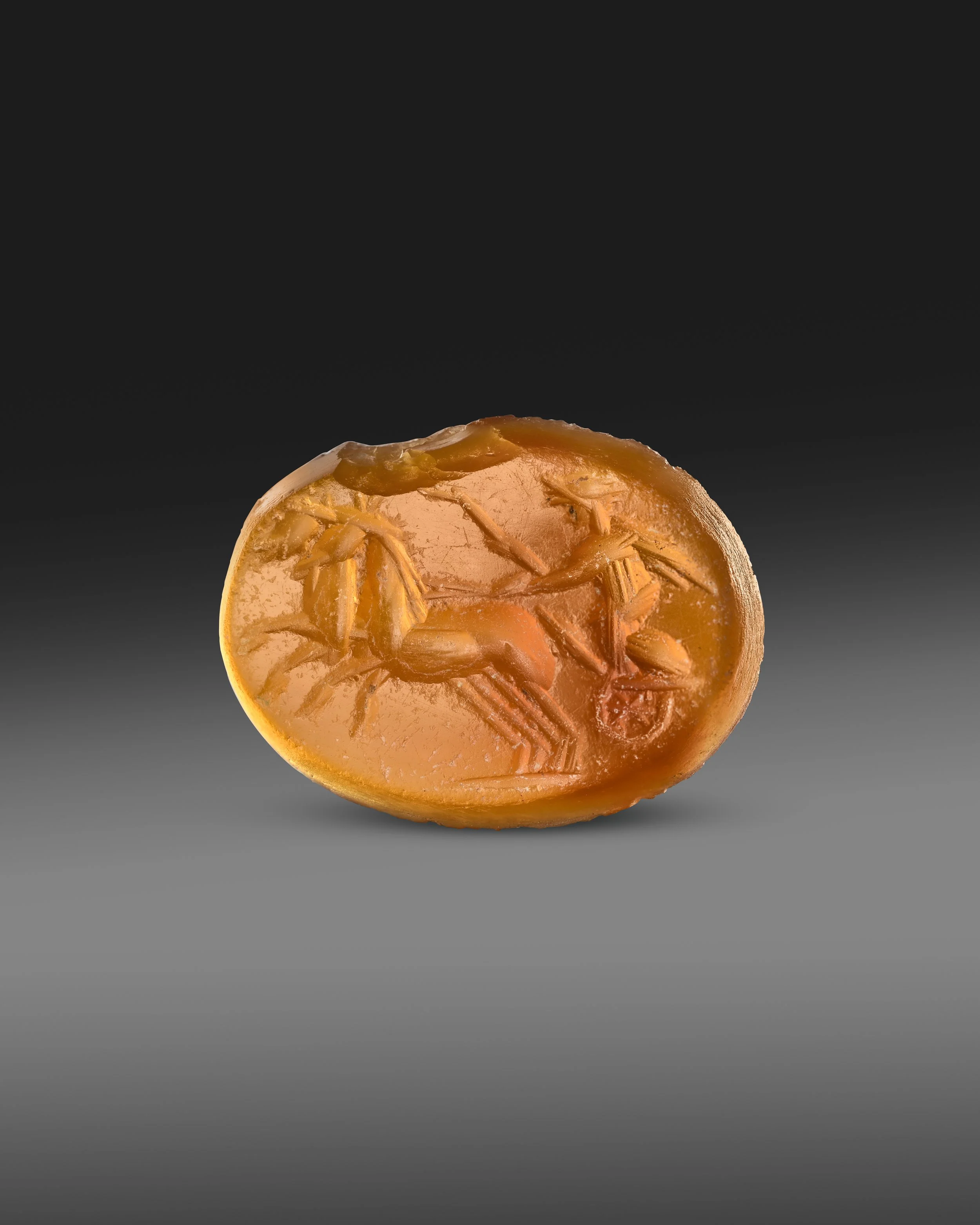
Deep orange translucent carnelian oval tapered tablet intaglio depicting a winged Eros with a whip riding a chariot with two horses towards the left.
Eros as a charioteer is a recurring iconographic motif in the Roman Imperial period. The chariot is typically drawn by various animals, such as the butterflies depicted in the Leiden example. This imagery is commonly interpreted as Eros guiding the soul (psyché) of the beloved, symbolized by the butterflies. When horses are employed, the motif takes on a more agonistic character, evoking the notion of victory in love. Such engraved gems were likely intended as personal tokens, possibly alluding to the successful fulfilment of an amorous relationship.
Carnelian is a type of chalcedony, a variety of polycrystalline quartz that displays a vitreous lustre.
Literature: Similar examples are found in the British Museum (sard, 1st-2nd century AD, inv. 1842,0728.31) and the Rijksmuseum van Oudheden, Leiden (orange carnelian, 1st century AD, inv. GS-00209).
c. 1st-2nd century AD
Length: 15mm, width: 12mm, depth: 3mmIntaglio of Eros as a charioteer
Deep orange translucent carnelian oval tapered tablet intaglio depicting a winged Eros with a whip riding a chariot with two horses towards the left.
Eros as a charioteer is a recurring iconographic motif in the Roman Imperial period. The chariot is typically drawn by various animals, such as the butterflies depicted in the Leiden example. This imagery is commonly interpreted as Eros guiding the soul (psyché) of the beloved, symbolized by the butterflies. When horses are employed, the motif takes on a more agonistic character, evoking the notion of victory in love. Such engraved gems were likely intended as personal tokens, possibly alluding to the successful fulfilment of an amorous relationship.
Carnelian is a type of chalcedony, a variety of polycrystalline quartz that displays a vitreous lustre.
Literature: Similar examples are found in the British Museum (sard, 1st-2nd century AD, inv. 1842,0728.31) and the Rijksmuseum van Oudheden, Leiden (orange carnelian, 1st century AD, inv. GS-00209).